


The anti-grav racer from the Vectrex, on a console from 1977. One track in perspective, three rivals, three laps — a road that follows the track's curves, climbs and dips, drawn by the ARM on a Melody cartridge.
// The race
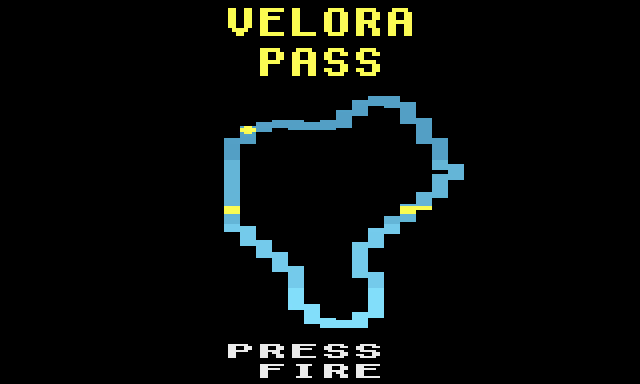
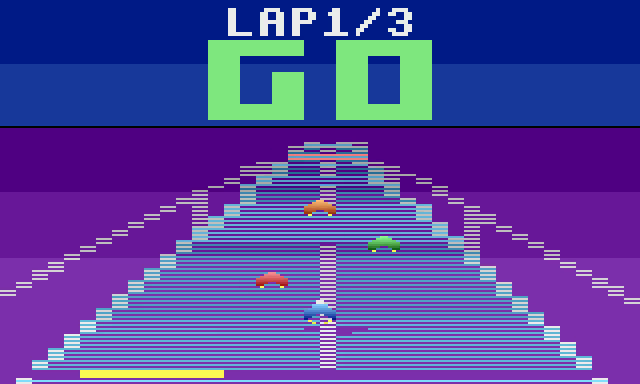
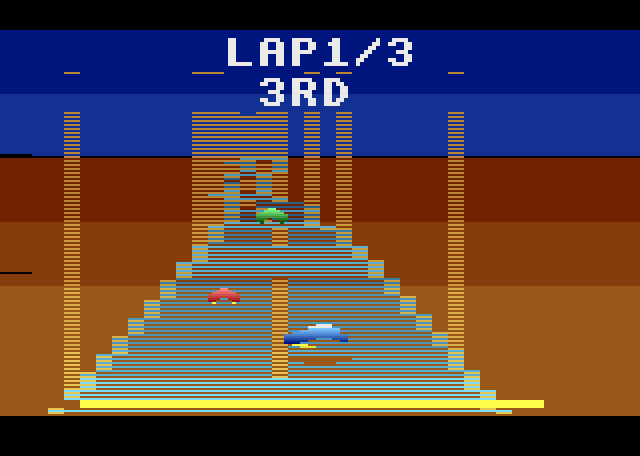
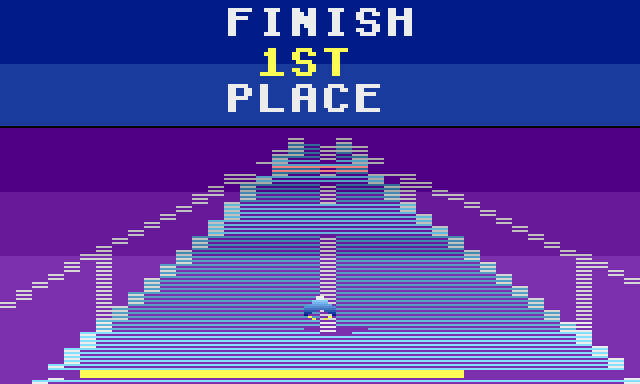
The start screen draws the track from above, with its name and a dot running round the map. Press fire and the countdown runs on the grid, your ship at the back of three rivals: 3, 2, 1, 0, GO. From there fire is the throttle. The sky counts your laps and your place; after the third, FINISH.
A curve pulls the ship outward with the speed squared, so a boost before a tight one is a decision. A hit on the wall costs speed and shakes the ship. The rivals each hold their own pace, change lanes, and take the boost pads on their side.
// How it works
The ARM on the cartridge projects the track's rings ahead of the ship with fixed-point arithmetic and scan-converts the road into a 40 × 192 playfield framebuffer. The whole picture is interleaved, the way DUSK MANOR's floor is: the road's surface on the even lines, its edges, centre line, walls and pads on the odd ones, each in colours of its own.
The 6507 serves the beam with the kernel from ATARI 2600 MASTERY, chapter 16, and the race's text is the book's chapter 28 text line. The engine and the race's sound effects play on the TIA's own two channels.
// What it is
This shows that a racer in perspective runs on the 2600. It is not the full game.
// The full game
The complete game — eight ships, weapons and a championship — is being built for the real Vectrex, on its own cartridge.